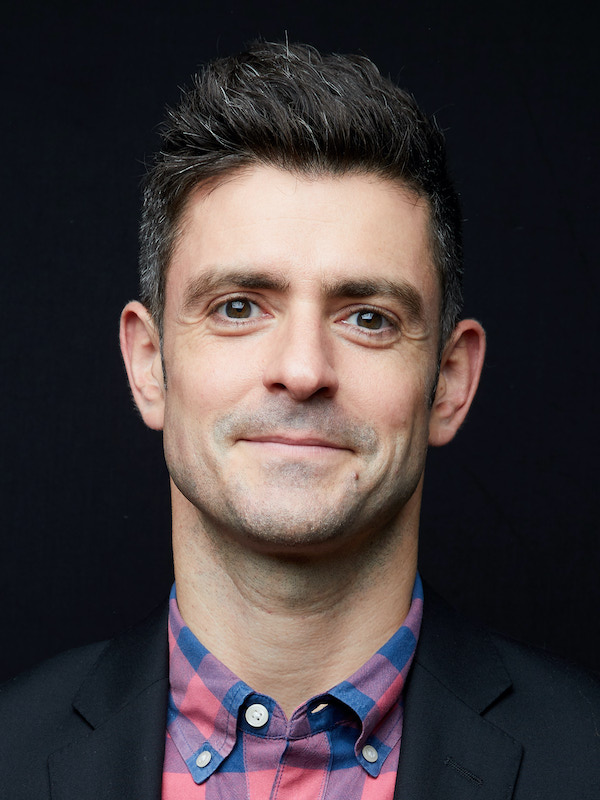
Daniel ErkerAssistant Professor, Spanish and Linguistics |
|
|||||||||||
|
[See also his faculty profile in Romance Studies. Please note that Prof. Erker's office is located in 718 Commonwealth Avenue.]
BA, Marquette University
MA, Graduate Center of the City University of New York
PhD, New York University
Professor Erker teaches courses in general linguistics and Spanish linguistics. His research interests include language variation, contact, and change, acoustic and articulatory phonetics, Spanish in the United States, the languages of Latin America, and the evolution of human language.
Professor Erker is currently developing the Spanish in Boston Research Project, a community based study which examines how Spanish is spoken in the greater Boston area.
His publications include "A subsegmental approach to coda /s/ weakening in Dominican Spanish" and "The Role of Lexical Frequency in Syntactic Variability" (with Gregory Guy, forthcoming in Language, 88:3).
Danny Erker says hello :-)
Click on the picture to play the video.
Courses |
|||||||
Fall 2013 |
|||||||
| Course number | Course title | Section | Instructor | Days | Time | Room | |
| CAS LS/LX 420 | Spanish in the United States | A1 | Erker | TR | 2-3:30 | CAS 235 | |
| (Conducted in Spanish) An ethnographic survey and sociolinguistic analysis of the Spanish language as it is spoken in urban USA. The course will focus on issues of language and dialect contact, language change, the fraught notion of 'heritage' speakers, and also code-switching as a sociolinguistic phenomenon. [Prereq: CAS LS 212 and CAS LX 250] | |||||||
| |||||||
| CAS LS/LX 507 | The Sounds of Spanish | A1 | Erker | TR | 9:30-11 | CAS 323A | |
| (Conducted in Spanish) The goal of this course is to introduce students to the linguistic analysis of speech, with a focus on the Spanish language. We examine the vowels and consonants of Spanish from the perspective of articulatory and acoustic phonetics. In addition, the course introduces core concepts in phonological analysis, surveying the phonemic inventory and phonological organization of Spanish. We also investigate a range of regional variation demonstrated by so-called ‘dialects’ of Spanish, with an emphasis on the historical and social significance of such variation in Spain, Latin America, and the United States. In summary, this course aims to examine the sounds of Spanish as physical, mental, and social phenomena. [Prereq: CAS LS 303 and CAS LX 250 or consent of instructor] | |||||||
| |||||||
Spring 2014 (tentative) |
|||||||
| Course number | Course title | Section | Instructor | Days | Time | Room | |
| CAS LS/LX 508 | The Structure of Spanish | A1 | Erker | MWF | 12-1 | TBA | |
| (Conducted in Spanish) The goal of this course is to introduce students to the structure of the Spanish language, with a focus on its morphology and syntax. We examine the internal structure of words and the inflectional and derivational processes that constrain them. In addition, the course introduces key concepts such as morpheme, affix, grammatical class, linguistic gender, nominalization, and verbalization. We also investigate fundamental principles of syntactic theory and analysis, with an emphasis on the hierarchical relationships among words at the phrasal level. We use naturalistic speech data, collected from around the Spanish-speaking world, to critically examine key assumptions and tools of contemporary syntactic theory, including X-bar theory, binary branching, thematic role assignment, and the concept of the sentence. We give special attention the notion of ungrammaticality as it relates to syntactic and morphological variation and change. [Prereq: CAS LS 303 and CAS LX 250 or consent of instructor] | |||||||
| |||||||
| CAS LX 320 | Language, Race, and Gender | Erker | MWF | 10-11 | TBA | ||
| Do women talk differently from men? How do race and ethnicity relate to the way people use language? This course examines these inter-related questions from the perspective of modern sociolinguistic theory, analyzing a range of languages and communities throughout the world. [Prereq: CAS LX 250 Introduction to Linguistics or consent of instructor.] | |||||||
| |||||||
